
Last updated November 2, 2026
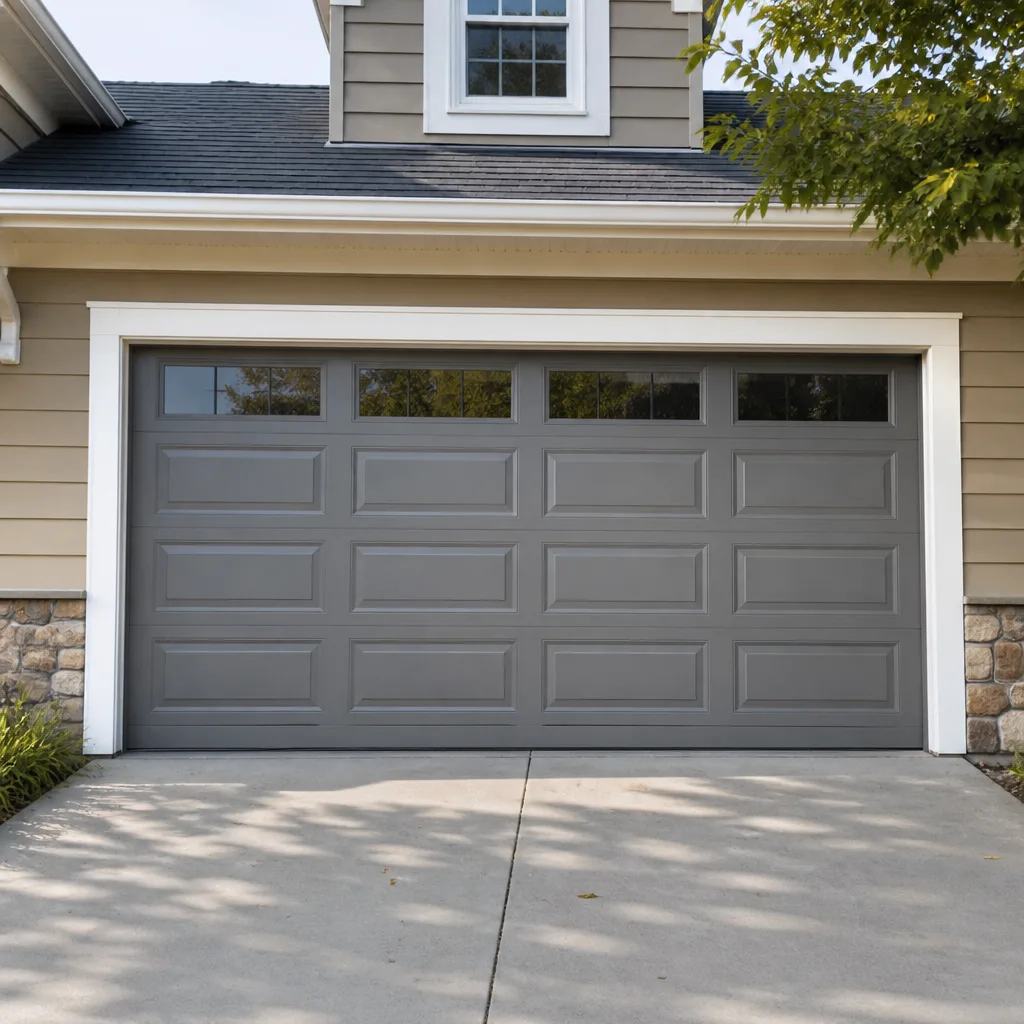 Raised-panel steel
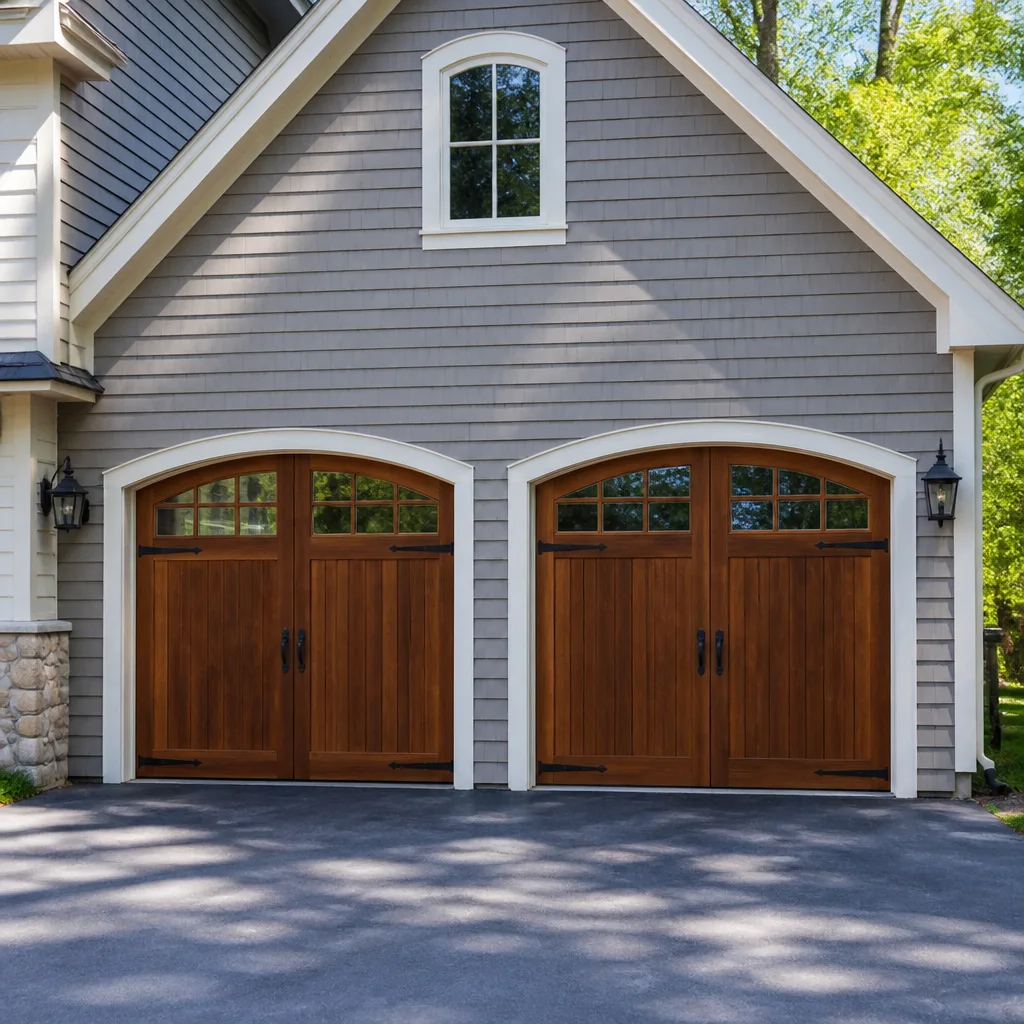 Carriage house
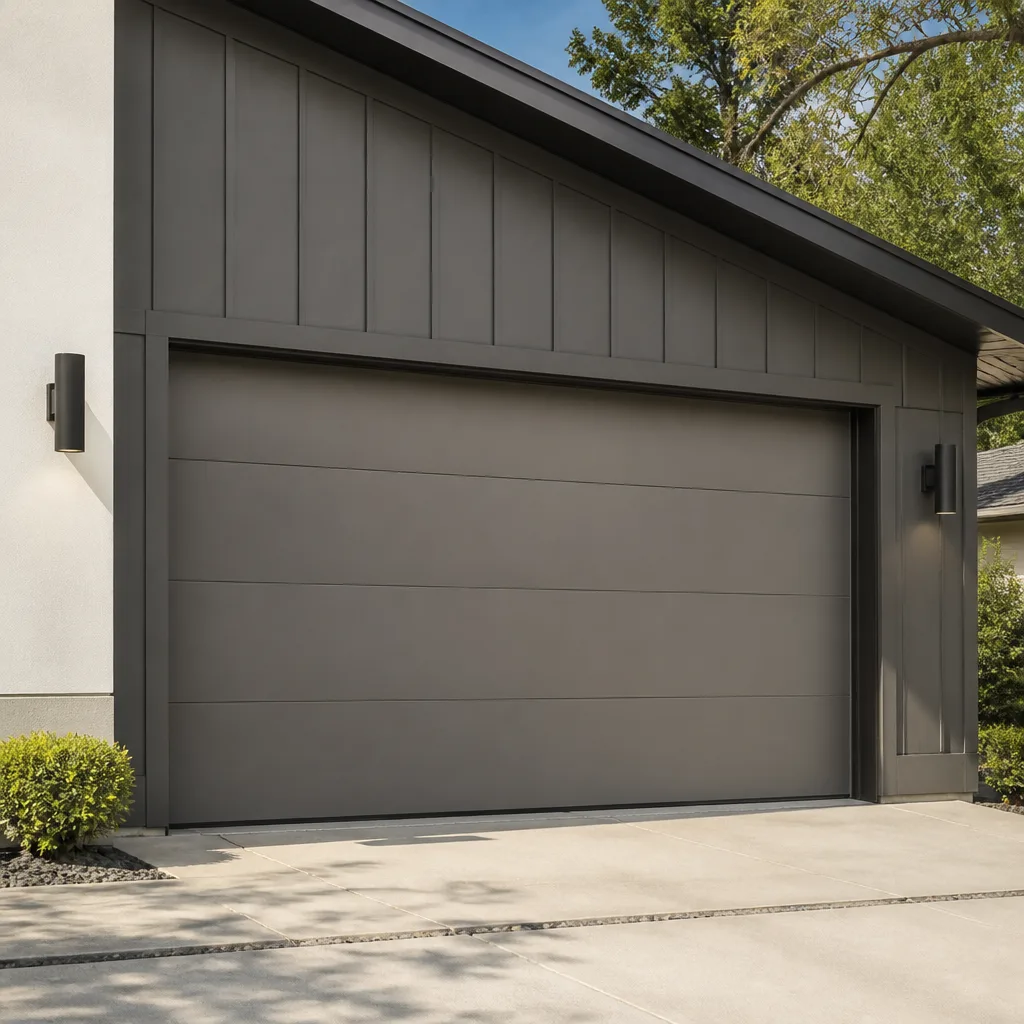 Modern flush
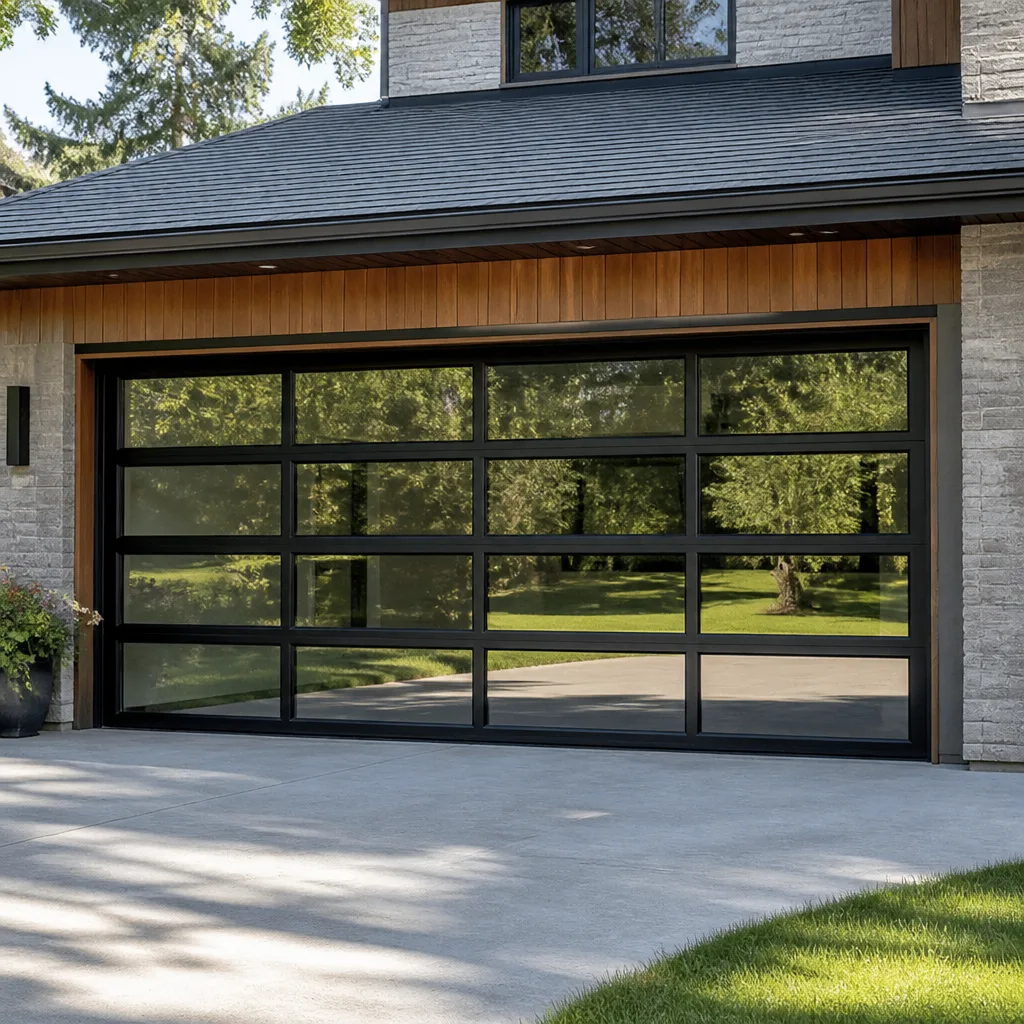 Full-view glass
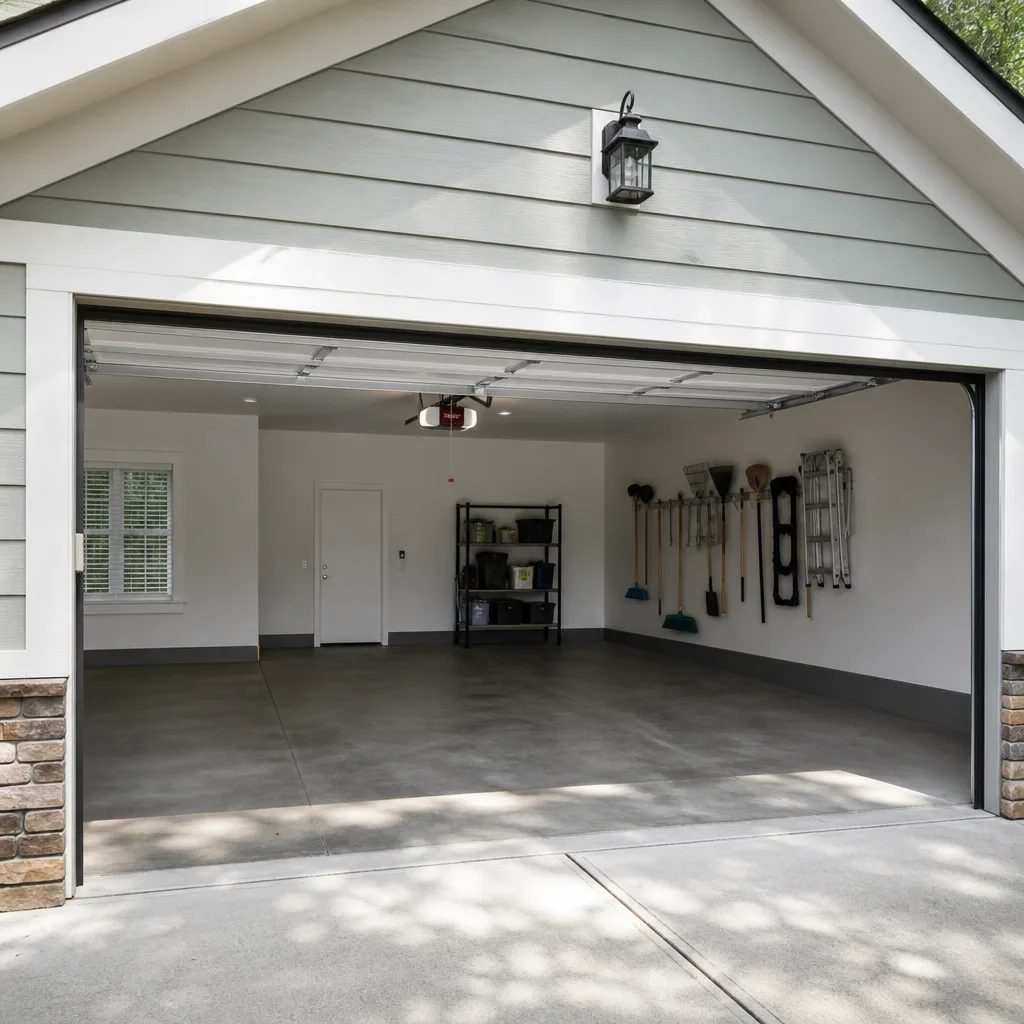 LiftMaster openers
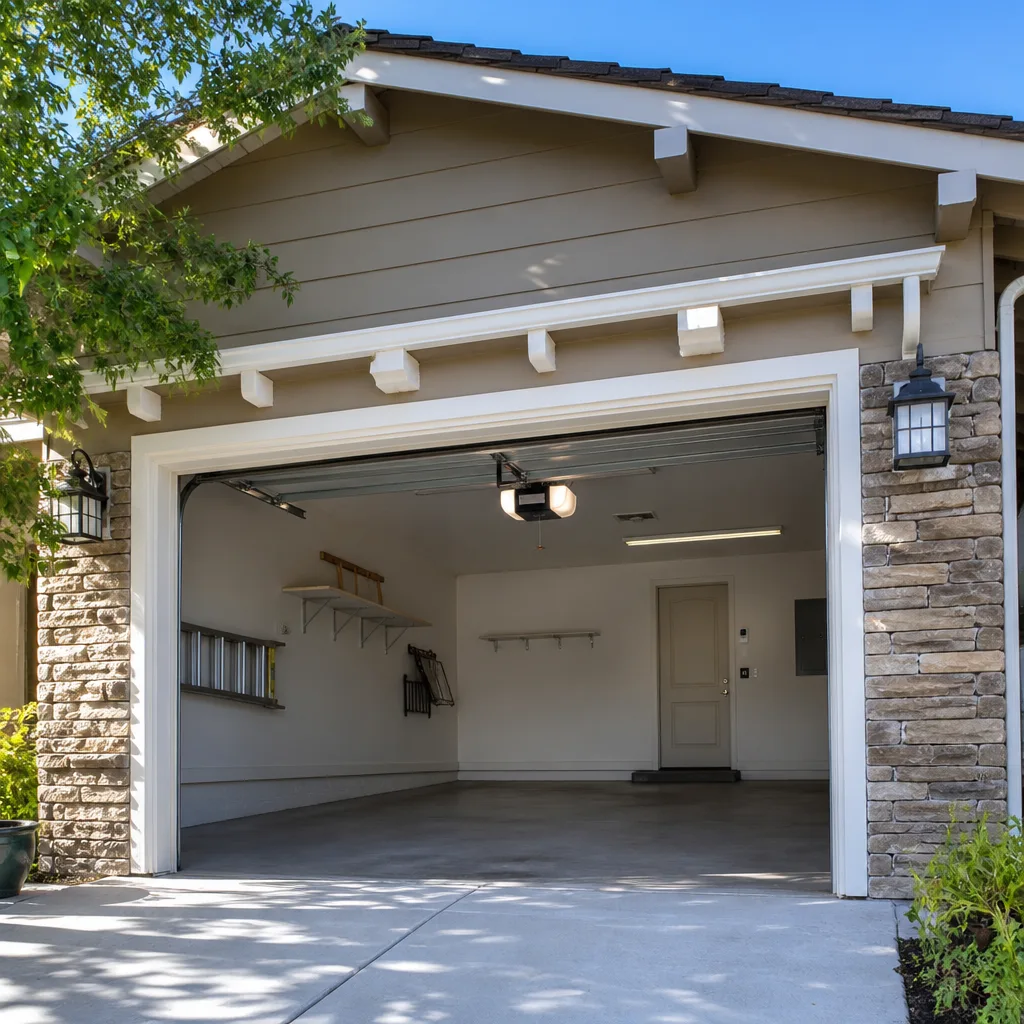 Chamberlain openers
Full 25-point door and opener safety check with every visit - springs, cables, rollers, tracks, and your LiftMaster or Chamberlain opener included
You get a price before we start. It does not change when the truck arrives.
Get your free estimateDIY vs Professional Garage Door: The Pomona Homeowner’s Decision Guide
Here’s a number most Pomona homeowners have never heard: a standard torsion spring on a 16-foot garage door stores somewhere between 700 and 900 inch-pounds of torque when wound to tension. In practical terms, that’s roughly the kinetic energy of a .22 caliber round at close range. Nobody hands a toddler a loaded pistol and says “figure it out,” yet every year thousands of capable, intelligent homeowners take a pair of winding bars to a fully-loaded torsion assembly without understanding what they’re releasing. This guide isn’t about scaring you out of touching your garage door. It’s about drawing a clear, honest line between the tasks where your wrench and your Saturday morning are enough, and the tasks where the physics itself demands a professional. We’ve spent years working on garage doors across Pomona, from historic bungalows near Lincoln Park to newer builds in Phillips Ranch, and we’ll tell you exactly where that line sits.
Styles & brands we work with
- Raised-panel steel
- Carriage house
- Modern flush
- Full-view glass
- LiftMaster openers
- Chamberlain openers
Quick Answer
Most garage door maintenance tasks, like lubricating rollers and tightening loose hardware, are genuinely DIY-friendly. But the moment a repair involves torsion springs, cables under tension, or opener reprogramming tied to safety-sensor alignment, the risk profile shifts from inconvenient to genuinely dangerous, and in Pomona the cost of a professional repair is almost always lower than the cost of fixing a botched DIY attempt. The honest rule: if the repair requires releasing stored mechanical energy, call a professional. If it’s cleaning, lubing, or visual inspection, grab your tools.
Table of Contents
- The Risk Ceiling: What Actually Makes a Job DIY-Safe
- Torsion vs. Extension Springs: Why the Distinction Matters
- How Missing One Tool Changes the Entire Risk Profile
- The Real Cost-Benefit Math of DIY Garage Door Work
- California Liability and Warranty Implications of DIY Work
- What Pomona’s Climate and Housing Stock Mean for Your Door
- Common Mistakes to Avoid
- When to Call a Professional
- Frequently Asked Questions
- The Bottom Line
The Risk Ceiling: What Actually Makes a Job DIY-Safe
The DIY decision isn’t about how handy you are. It’s about whether the task has a “risk ceiling” you can see and manage, or whether the ceiling is invisible until it’s too late. A risk ceiling is the worst-case scenario if something goes wrong. For cleaning photo-eye sensors on a LiftMaster opener, the worst case is you bump the sensor and it needs realignment. For replacing a bottom seal on a Clopay door, the worst case is you waste a strip of rubber and try again. These tasks have low risk ceilings. You can see the worst case before you start.
Here’s how we categorize garage door tasks by risk ceiling. This is the framework we use when Pomona homeowners ask us whether they can handle something themselves – drawn from our Garage Door Emergency Preparedness Guide for Pomona Homes:
- Green zone (DIY-safe, minimal tools, low consequence): Lubricating rollers, hinges, and springs with a white lithium or silicone spray; tightening visible nuts and bolts on the track brackets; cleaning and aligning photo-eye sensors on LiftMaster, Chamberlain, Genie, or Craftsman openers; replacing remote batteries; clearing debris from the bottom track; painting a steel door surface after proper prep.
- Yellow zone (DIY-possible with research, medium consequence if wrong): Replacing a worn bottom seal or weatherstripping; replacing a damaged roller on a side-mounted hinge; adjusting the opener’s force settings; resetting a myQ or Aladdin Connect WiFi connection; replacing a broken hinge; rebalancing a slightly-off door with minor spring adjustments (extension spring systems only).
- Red zone (professional-required, high or catastrophic consequence): Replacing or rewinding torsion springs; replacing lift cables; any work involving the spring anchor bracket or center bearing plate; replacing an opener motor with a different brand or horsepower class; re-tensioning an extension safety cable; structural track replacement.
The reason yellow and red zones are separated isn’t elitism. It’s the difference between a mistake you can see and fix, and a mistake you can’t see until the spring lets go.
Torsion vs. Extension Springs: Why the Distinction Matters
Most Pomona homes built before 1990 originally had extension springs. These are the two long springs that stretch along the horizontal tracks on either side of the door. They’re visible, they look approachable, and they’re still dangerous if you don’t know what you’re doing. But their mechanics are simpler: when the door closes, the springs stretch. When it opens, they contract and pull. If an extension spring snaps, it has a safety cable running through its center (on code-compliant installs) that keeps it from flying across the garage.
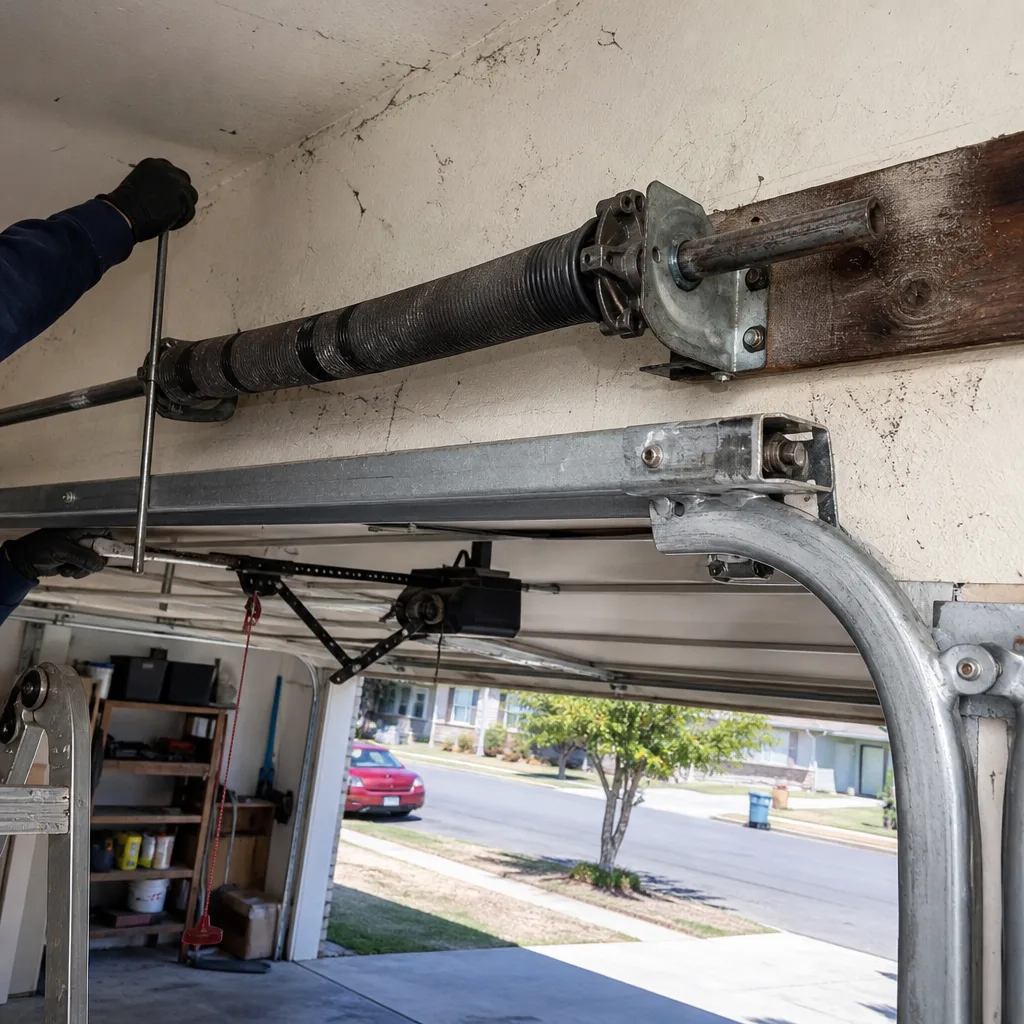
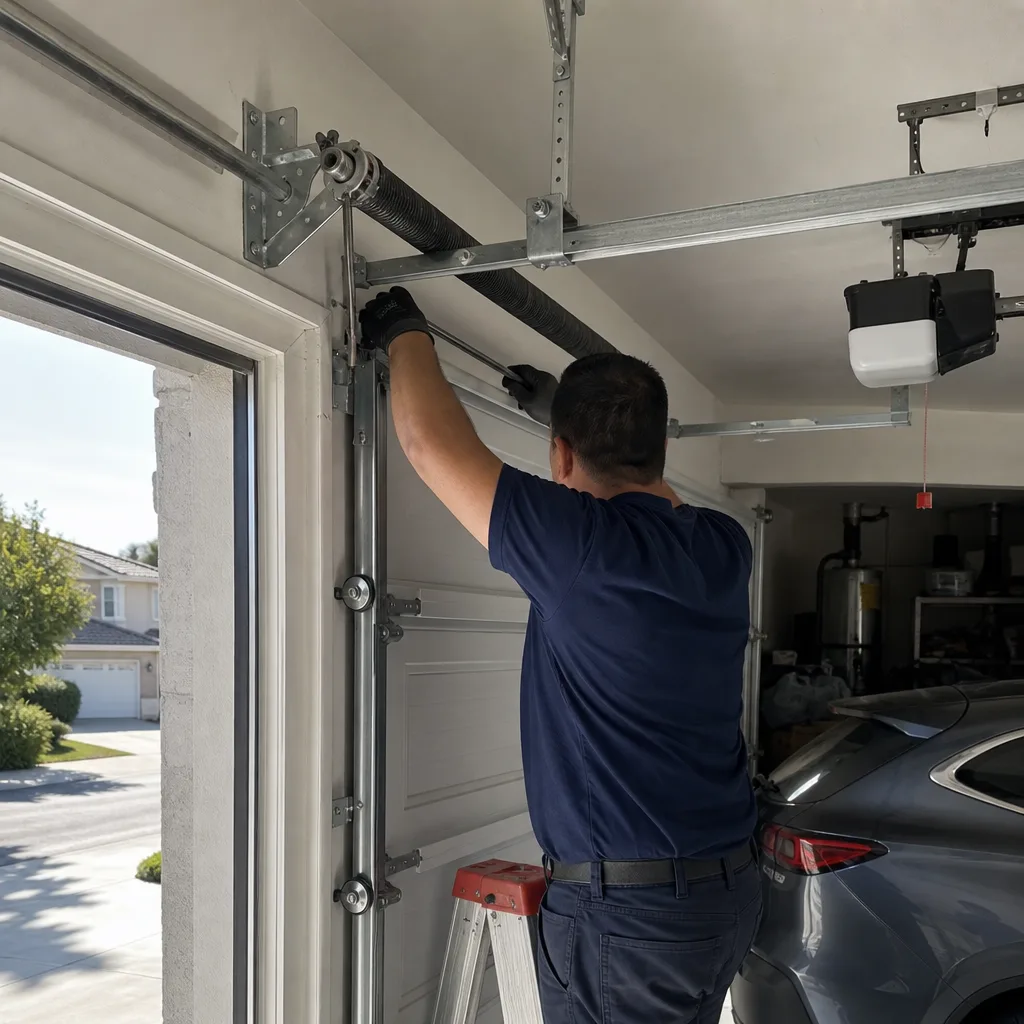
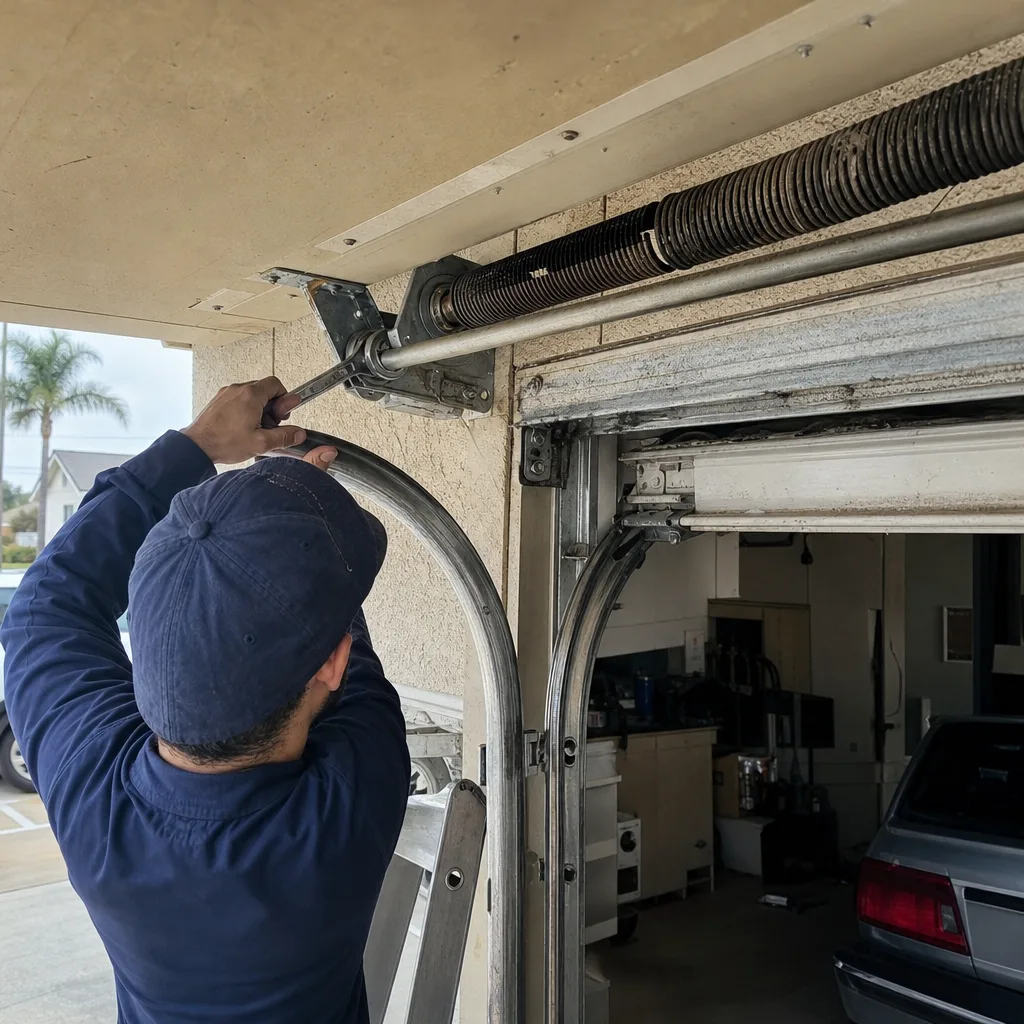
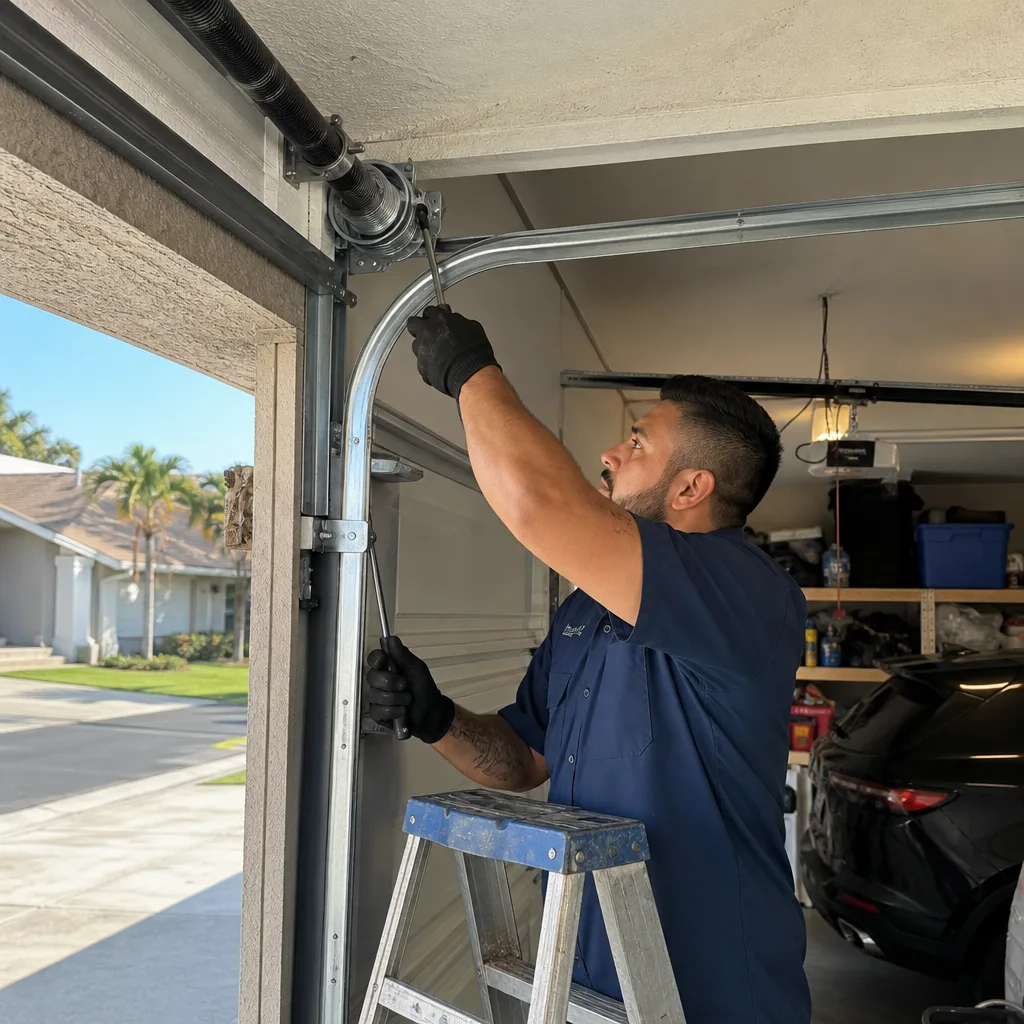
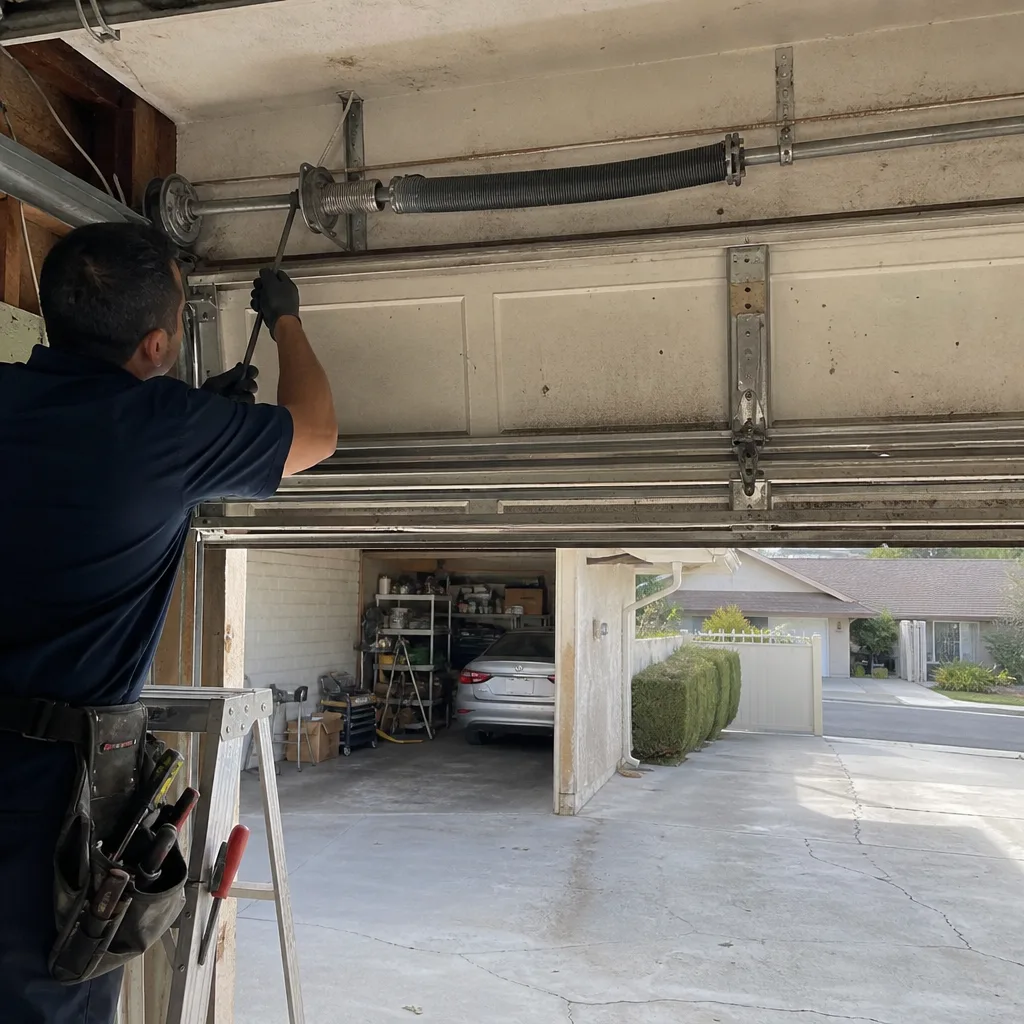
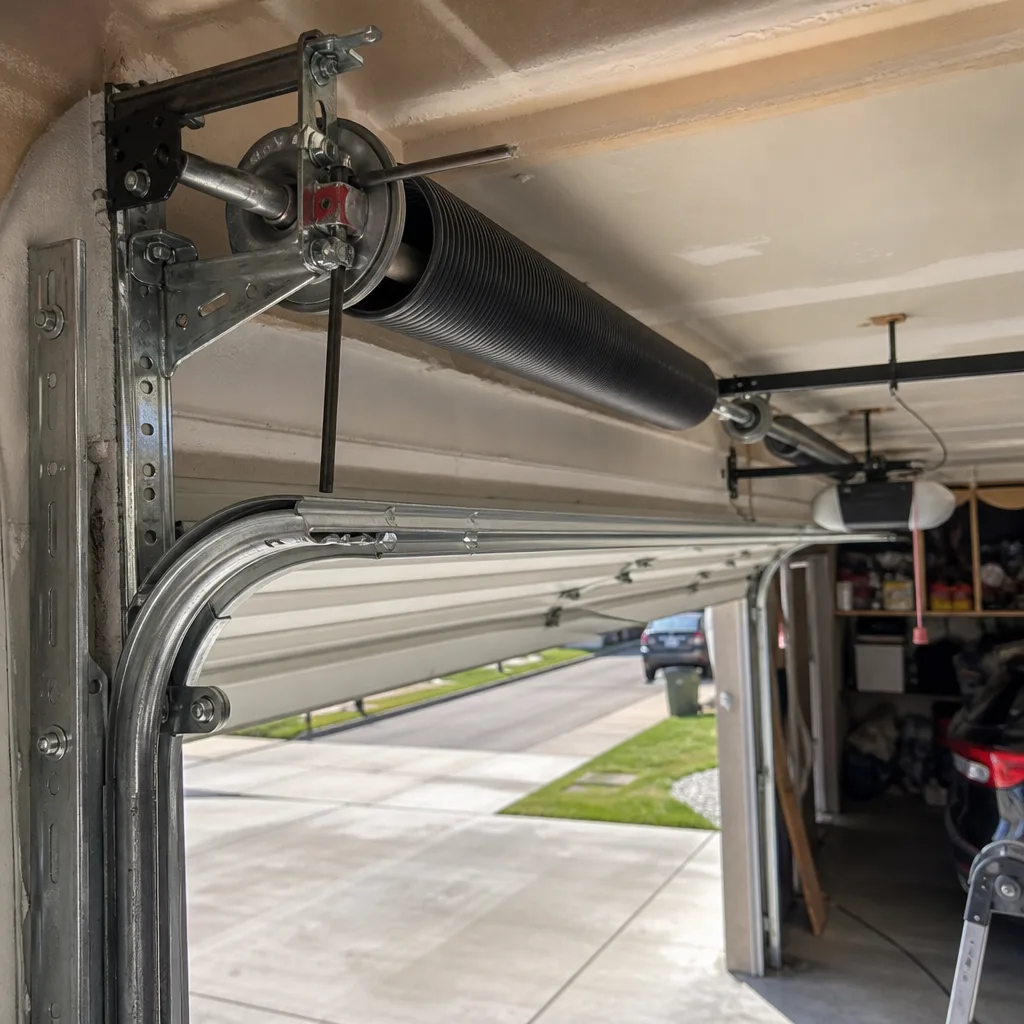
Torsion springs are categorically different. A torsion spring mounts on a steel rod above the door’s center. It doesn’t stretch. It winds. When a professional installs or repairs a torsion spring, they use hardened steel winding bars and add or remove quarter-turns of tension until the spring’s stored torque exactly balances the door’s weight. A 16-by-7 steel Amarr door typically needs between 7 and 9 full turns per spring depending on weight. At 9 turns, that spring is holding hundreds of inch-pounds of torque in a coil the diameter of a coffee mug.
Here’s the part competitors’ guides gloss over: you cannot “see” torsion spring tension. The spring doesn’t look loaded. It doesn’t sag, stretch, or bulge. A fully-wound torsion spring looks almost identical to an unwound one. The tension is invisible. That’s why the injury rate from torsion spring work is what it is, and why the standard professional protocol is to treat every torsion spring as if it’s fully wound until you’ve personally unwound it with the correct bars.
If your Pomona home has torsion springs and one breaks, do not touch it. The door will be heavy, possibly unmovable, and the spring itself may have sharp ends. Call us at (866) 282-7068. We service Garage Door Repair in Pomona and carry torsion springs sized for Clopay, Amarr, Wayne Dalton, and Raynor doors on our trucks.
How Missing One Tool Changes the Entire Risk Profile
A task that’s safe with the right tool becomes dangerous without it. This is obvious in theory and ignored in practice. Here’s the specific tool list for legitimate DIY garage door work, and what happens when you substitute:
Lubrication and inspection requires nothing special: a can of white lithium or silicone spray, a rag, a flashlight, and a ladder if you’re short. There’s no dangerous substitute for a missing tool here. Worst case: you get grease on your shirt.
Replacing a bottom seal requires the correct-width seal profile for the door brand, a utility knife, and depending on the door, a ratchet set to loosen the retainer channel. If you don’t have the right width seal and decide to “make it work” with a wider strip, you’ll create friction against the track that accelerates roller wear and can bind the door. The fix for the wrong seal is a new seal. Low stakes, correctable.
Replacing a torsion spring requires two winding bars of the correct diameter for the spring’s winding cone. Not a screwdriver. Not a pry bar. Not a piece of rebar. Winding bars are round steel rods, usually 18 inches long, with a working end machined to fit the cone’s holes precisely. They give you full hand-and-body control over the quarter-turn winding process. A screwdriver in a winding cone will slip. When it slips, the cone releases all stored torque instantly, the door slams, and the bar becomes a projectile. There is no “close enough” tool for torsion springs. If you don’t own winding bars, you don’t have the option of trying.
Testing door balance requires disconnecting the opener and manually lifting the door to half-height. If the door doesn’t stay put, the springs are out of sync with the door’s weight. This is diagnostic, not a repair, but it’s the single most useful DIY check you can do. If your Pomona door drifts down at half-height, the springs are doing too much or too little, and that’s a spring issue, not an opener issue. Your opener’s motor has been compensating for the imbalance, which is exactly how opener gears strip and circuit boards fry. Door side or opener side, we diagnose both. That’s why our Garage Door Opener Repair in Pomona service starts by checking the door’s mechanical health before touching the opener.
The Real Cost-Benefit Math of DIY Garage Door Work
DIY saves money when the failure cost is low and the success skill is common. It loses money when the failure cost is high, the skill is specialized, or the repair has a hidden learning curve. For a deeper look at what different repairs cost, see our Garage Door Cost Breakdown: The Pomona Homeowner’s Reference for 2026. Here’s the actual math for Pomona homeowners, based on what we see in the field:
| Task | DIY Cost | Professional Cost | Downtime if Botched | Verdict |
|---|---|---|---|---|
| Lubricate and inspect | $8-$15 (spray can) | $75-$125 tune-up | None | DIY green light |
| Bottom seal replacement | $25-$60 (seal + hardware) | $120-$190 | 1-2 days (if wrong width) | DIY-fine with correct part |
| Photo-eye sensor realignment | $0 (just needs patience) | $85-$140 service call | Same day | DIY green light |
| Single torsion spring replacement | $60-$120 (parts only) | $220-$380 installed | Door unusable if repair fails | Professional only |
| Cable replacement | $30-$60 (cables only) | $180-$290 installed | Door falls or jams if wrong | Professional only |
| Full opener replacement | $250-$500 (opener only) | $500-$900 installed | Days, plus possible door damage | Professional recommended |
| New full door installation | N/A (not DIY-achievable) | $1,500-$5,000+ installed | N/A | Professional only |
Notice the pattern: in every case where DIY is genuinely workable, the professional cost is under $200 and the DIY savings are marginal. In every case where the professional cost passes $300, the DIY failure cost is several times the professional price. A botched torsion spring attempt in Pomona typically means a car trapped in the garage, a door that won’t open, and a repair bill that now includes undoing whatever went wrong. The $80 you saved by buying the spring yourself disappears instantly when we have to replace a bent torsion rod or a stripped winding cone.
For the other side of the equation: Garage Door Installation in Pomona is not a DIY project under any circumstances. Doors arrive in sections that weigh hundreds of pounds collectively. The springs must be wound after the door is hung, the tracks must be square to within an eighth of an inch, and the opener must be programmed to the door’s exact travel limits and force profile. We carry and install Clopay and Amarr doors and have installed enough of them to know where each brand’s quirks show up during assembly. That knowledge is the difference between a door that runs smooth for 15 years and a door that starts binding in month 6.
California Liability and Warranty Implications of DIY Work
California homeowners carry more liability than they realize when they perform their own garage door repairs, and the warranty implications are rarely discussed until it’s too late. For details on permits and legal requirements, read our Garage Door Permits, Codes & Inspections in CA: What You Need to Know. Here’s what the fine print says:
Opener warranties void on conflicting opener installation. If you install a Chamberlain opener and later the logic board fails, Chamberlain will ask whether the door was balanced at the time of installation. If the answer is “I don’t know” or “the door seemed fine,” that’s a warranty denial path. Most opener manufacturers, including LiftMaster and Genie, explicitly state that opener warranties don’t cover failures caused by an unbalanced door or incorrect force settings. A door that wasn’t properly balanced after a DIY spring swap will eventually destroy the opener’s gear and sprocket assembly. When that happens, the opener warranty won’t help you.
Door warranties often require professional installation for coverage. Clopay, Amarr, Wayne Dalton, and Raynor all sell to both professionals and homeowners, but their warranty language typically distinguishes between “proper installation” and “installation by a qualified professional.” If a section cracks or a hinge tears out and the door wasn’t installed by a professional, the manufacturer has a defensible position to deny the claim. We navigate this on a regular basis.
Homeowner’s insurance may not cover DIY-adjacent damage. If a DIY cable replacement fails and the door drops onto your car, your auto insurance may cover the car but your homeowner’s insurance may not cover the garage door’s damage if the adjuster determines the repair was performed by an uninsured party (you). A licensed professional’s general liability insurance takes that problem off your plate entirely.
Four points by point summary of California DIY liability:
- Opener warranties rely on proper door installation and balance. DIY spring work can void that coverage silently.
- Door panel warranties require professional installation for structural claims. A cracked section from a misaligned install isn’t covered.
- Your homeowner’s insurance doesn’t cover damages caused by your own unlicensed repair work in most cases.
- A professional’s insurance covers their work. Yours doesn’t cover yours. That asymmetry is the entire ballgame.
When you hire us, the work is done by a state-licensed, insured and bonded professional. We carry the insurance that answers for our work. If you do the work yourself, you’re carrying the entire liability load alone.
What Pomona’s Climate and Housing Stock Mean for Your Door
Pomona sits in the Pomona Valley, which means hot, dry summers with regular temperature swings above 90 degrees and into the 100s, mild wet winters, and enough Santa Ana wind events to matter for exterior anything. Here’s how that affects your garage door specifically:
Heat expands and contracts the metal. Steel doors in Pomona go through a daily cycle of expansion and contraction from May through October. Hinges loosen, fasteners back out, and the door’s balance shifts subtly as components settle. This is why a door that was perfectly balanced in March can be slightly off by August. A five-minute visual inspection every three months catches loose bolts before they become track misalignments.
Santa Ana winds carry dust and fine grit. That grit lands on horizontal surfaces, including garage door tracks and opener rails. Mixed with the white lithium grease many homeowners apply too liberally, it creates a grinding paste that accelerates roller and hinge wear. The fix is simple and DIY: use a dry silicone spray instead of grease, wipe the tracks clean with a dry rag, and don’t over-lubricate.
Older Pomona housing stock has wood doors. Homes near downtown Pomona and around the Pomona College area often still have original wood sectional doors from the 1960s and 1970s. Those doors are heavy. They may weigh more than modern steel doors of the same size, and their spring systems are often original or decades old. If you own a wood door, the DIY math changes: any spring or cable work is even more risk-laden because the loads are higher and the hardware is fatigued. And if you’re considering replacing that wood door, you’ll find that the spring and opener requirements differ significantly from a lightweight modern insulated steel door. We service the whole spectrum; our home base is Garage Door Service Pomona home for a reason.
Neighborhood-by-neighborhood reality:
- Phillips Ranch and newer west Pomona builds: Mostly modern steel doors with torsion springs, often with LiftMaster or Chamberlain smart openers. Common issues are sensor misalignment from kids’ bikes and spring fatigue from daily use. Regular lubrication and balance checks every six months are sufficient.
- Lincoln Park and historic Pomona neighborhoods: Older doors, heavier wood construction, more extension spring systems, and a higher share of original hardware. Annual professional inspections catch fatigue cracks before they snap.
- Ganesha Hills and hillside homes: Sloped driveways mean the garage door is often the primary entrance. Daily multiple cycles. Increased spring wear. These are the doors that fail at the worst possible moment, usually Monday morning.
Common Mistakes to Avoid
- Applying WD-40 to garage door rollers. WD-40 is a water displacer and solvent, not a lubricant. It’ll clean briefly, then strip whatever lubricant was there and leave the roller bearings dry. Use white lithium or silicone spray instead.
- Using a screwdriver or pry bar on a torsion spring winding cone. The cone’s holes are machined for winding bars. Anything else will slip under load, and the projectile energy of a slipping bar at full tension is lethal. There is no improvisation here.
- Continuing to use the opener when the door is clearly struggling. If your opener grinds, strains, or reverses unexpectedly, every additional cycle is damaging the gear train. The motor is working against an unbalanced door or a failing spring. Shut it off and call before the opener needs replacing too.
- Replacing one torsion spring when the door has two. Torsion springs are installed in matched pairs on 16-foot doors. If one breaks, the other is likely near the end of its cycle life too. Replacing only one creates an imbalance that shortens the life of the new spring. Always replace both. Professional shops do this by default.
- Ignoring the safety cable on extension springs. Extension springs are under extreme tension when the door is closed. Without the safety cable running through the center of the spring, a snapped spring becomes a missile. If your Pomona garage has older extension springs without safety cables, budget to have them added.
- Reusing old cables “because they look fine.” Lift cables fray internally before they show external wear. A cable that’s been carrying load for 10+ years has microscopic fatigue you can’t see. Cables are cheap. A door dropping on your car or a person isn’t.
When to Call a Professional
Call a professional the moment any of these things happen: a torsion spring has snapped (you’ll hear it, it sounds like a gunshot from inside the garage); a lift cable is frayed or has jumped the drum; the door is stuck half-open and won’t move; the opener’s motor runs but the door doesn’t move; you’ve narrowed the problem to the spring system but don’t own winding bars; or you’re planning a full door replacement and need accurate weight and size measurements for spring matching. If the door is stuck closed with your car trapped inside, call us. We’ll quote the repair and the price is always agreed before any work starts. Garage Door Service Pomona offers free estimates in Pomona. Call (866) 282-7068 and we’ll get you sorted.
Frequently Asked Questions
Garage door repair in Pomona typically runs $125 to $380 depending on the component. A tune-up with lubrication and balance check costs $75 to $125. Bottom seal replacement runs $120 to $190. Single torsion spring replacement runs $220 to $380 installed with most brands including Clopay, Amarr, and Wayne Dalton. Cable replacement runs $180 to $290. Opener replacement ranges from $500 to $900 installed. Every job gets an upfront quote before any work begins. Call (866) 282-7068 for exact pricing on your door.
You should not replace a torsion spring yourself under any circumstances. The stored rotational energy in a wound torsion spring is enough to remove fingers or break bones if the winding bar slips, and the tension is invisible until it releases. Extension springs are marginally less dangerous but still capable of serious injury. This is the one repair where even experienced DIYers call professionals.
Lubricate your garage door every 3 to 4 months in Pomona’s dry climate. The heat accelerates lubricant breakdown and Santa Ana winds add grit that mixes with old grease. Use white lithium or silicone spray on hinges, rollers, and springs. Wipe tracks clean with a dry rag and never grease the tracks themselves.
Intermittent opener function in Pomona is usually either misaligned photo-eye sensors, a failing logic board from heat exposure in unconditioned garages, or the opener’s force settings fighting an unbalanced door. Clean the sensor lenses first. If the problem persists, the opener likely has a component failure or the door’s springs have fatigued. Call (866) 282-7068 and we’ll diagnose whether it’s the door side or the opener side.
Very likely yes. We service LiftMaster, Chamberlain, Genie, Clopay, Amarr, Wayne Dalton, Craftsman, and Raynor products across all three of our service lines: repair, opener repair, and full installation. Eight brands, one call. If the door or opener already in your Pomona garage is from one of these manufacturers, we carry compatible parts and we know the models.
No. The price we quote is the price you pay. If we discover something additional during the repair that needs attention, we’ll show you and quote the extra work before doing it. You decide. Nothing gets added to your invoice without your explicit approval first. That’s how we’ve operated in Pomona since the beginning.
The Bottom Line
Garage door work splits cleanly into tasks with visible failure modes and tasks with invisible stored energy. Clean it, lube it, inspect it, replace the seal, realign the sensors: all yours. Touch the torsion springs, cables, or full door installation: call a professional. The math supports this split too. The jobs where DIY makes financial sense are the jobs where the stakes are low. The jobs where the stakes are high are the jobs where professional insurance, training, and tooling pay for themselves the first time nothing goes wrong. In Pomona, we’ve seen the whole spectrum, and the line hasn’t moved. Door side or opener side, we diagnose both. Eight brands, one call. Call (866) 282-7068 for a free estimate and we’ll help you decide what’s worth your Saturday and what’s worth our expertise. For more guides & resources, visit our blog.
Written by the team at Garage Door Service Pomona, serving Pomona since 2016.
See the difference
 Before
 After
 Before
 After
 Before
 After